Waterjet cutting offers a versatile way to produce accurate profiles across a wide range of materials for small- or large-scale projects. Depending on the materials being processed, waterjet cutting can be used with either pure water or an abrasive, such as garnet.
When undertaking a new project, it can be particularly useful to understand the key difference between abrasive and pure waterjet cutting, helping you choose the right process for your material type, thickness, edge quality requirements and desired finished component.

What is Abrasive Waterjet Cutting?
Abrasive waterjet cutting combines an ultra-high-pressure stream of water with a fine abrasive agent, such as garnet. The addition of an abrasive increases the overall cutting power of the water, which allows this cutting method to work through thicker and harder materials. Depending on the project requirements, abrasives can be added in varying grades, from coarse to fine, which allows for greater control over edge quality and the final output, producing less waste and easier setup.
Abrasive cutting can be utilised across several materials and is particularly favoured for its ability to cut hard metals, such as Hardox steel. It is commonly used across stainless steel, mild steel, aluminium, titanium, copper, brass, glass, ceramics, composites, and more, handling materials up to 230mm thick, depending on the project requirements.
A core benefit of waterjet cutting is that it is a cold-cutting process; therefore, it does not introduce heat that is associated with thermal methods, such as laser cutting. This eliminates heat-affected zones (HAZ) and any unwanted thermal distortion, which is critical in components where strict dimensions, edge quality, and properties need to be maintained.
What is Pure Waterjet Cutting?
Pure waterjet cutting also uses a high-pressure stream of water, but without the abrasive additive. Because there is no garnet added, the cutting process is entirely intended to be used on softer materials, such as malleable metals, rubber, foam, plastics and textiles that do not require any additional force by abrasive agents.
This method is preferred over laser cutting where the material or cutting technique could be affected and damaged by thermal processes, while still maintaining quick speeds.
Abrasive vs. Waterjet Cutting
| Factor | Abrasive waterjet | Pure waterjet |
| Cutting medium | Water and garnet abrasive | High-pressure water |
| Suitable materials | Metals, stone, glass, ceramics and composites | Rubber, foam, fabric and softer plastics |
| Hard materials | Suitable | Generally unsuitable |
| Thick materials | Suitable for a wide range of applications | Better suited to softer materials |
| Heat generation | Cold cutting process | Cold cutting process |
| Applications | Industrial components, metal profiles and complex parts | Softer or delicate materials and detailed profiles |

Which Waterjet Method is Ideal for Your Application?
If you need to profile a metal with extra force, or another hard material, abrasive waterjet cutting is likely to be the most appropriate option. This is particularly useful for complex profiles and applications where heat from thermal cutting could affect the final component, while also ensuring there’s minimal need for secondary processing to achieve the desired edge quality. This can apply to projects, such as:
Aerospace: Titanium prototypes, engine parts, structural frames, cabin panels.
Automotive: Body panels, custom components, engine parts, structural frames.
Medical: Surgical instruments, prosthetics, medical equipment.
Architecture: Intricate patterns, bevels, panelling.
Electronics: Circuit boards, stripping cables, housing.
Pure waterjet cutting is best utilised when working with softer, delicate materials and designs that can be easily cut without an abrasive. This is ideal for applications such as:
Automotive: Foam insulation, textile interiors, carpets, rubber mat floors.
Food processing: Slicing foods with no risk of cross-contamination.
Textiles: Cutting materials into complex patterns ready to be assembled.
Packaging: Cardboard, packaging inserts, plastic parts.
Electronics: Delicate circuit boards and components.
Waterjet cutting can adjust speeds to balance edge finish and processing costs. Slower cutting produces a finer edge, while faster cutting can provide greater throughput where the highest edge quality is not required.
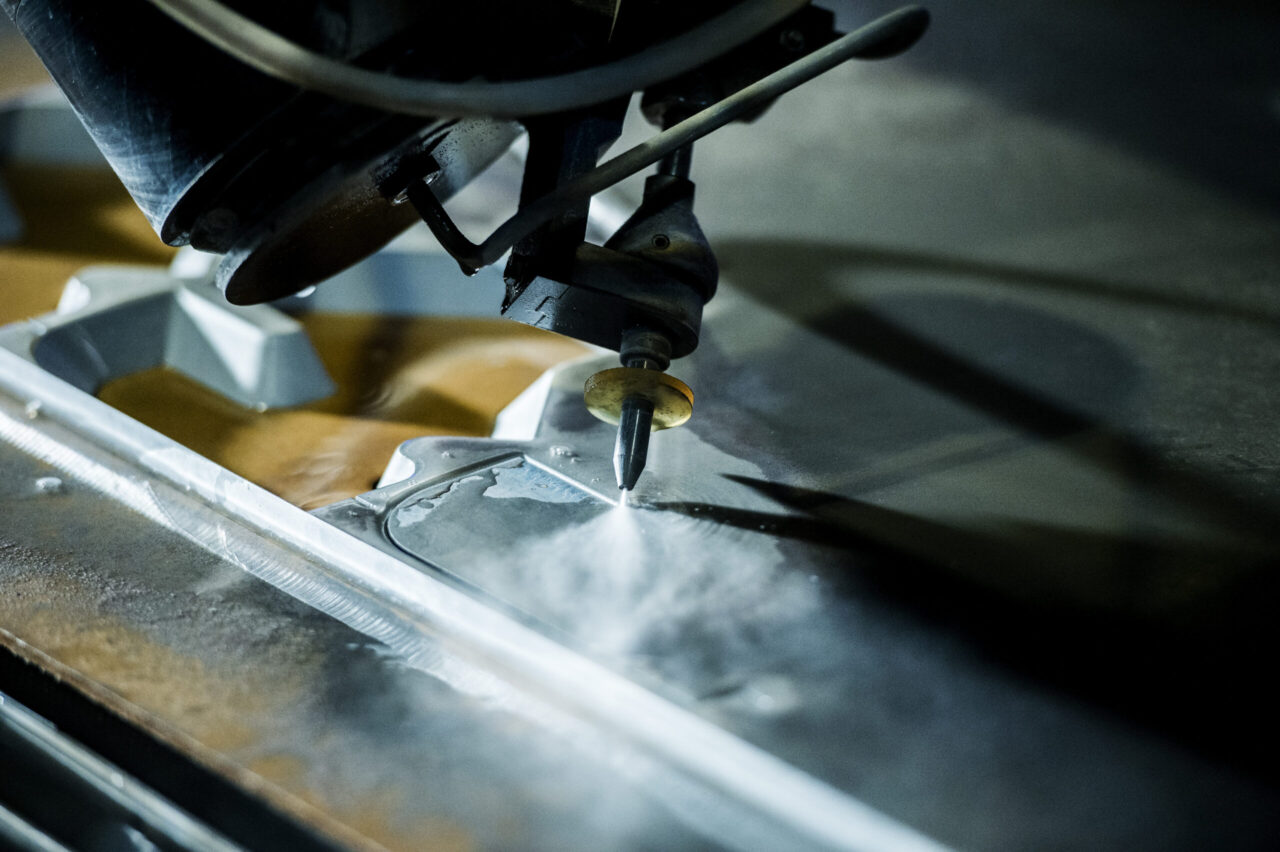
Professional Waterjet cutting from Charles Day Steels
Charles Day Steels provides both abrasive and pure waterjet cutting, with large-scale profiling capabilities and tolerances of up to ±0.25mm. Our waterjet facilities can process materials measuring up to 9m x 4m, supporting both complex components and larger profiles.
Choosing the right process starts with understanding your material, thickness, profile and required finish. Charles Day Steels can assess these requirements and identify the most suitable waterjet cutting approach for your project. Get in touch with a friendly member of our team for a quote today.